
If you’re in the market for a quality, solid hardwood table, but think you need to spend a ton of money to get one, think again. With our pre-milled slabs, there’s no need for specialty tools such as a planer or a router sled. There’s also no need for pro-level skills. All you need is familiarity with three basic power tools to achieve professional results. Let’s take a look. Here’s what you need:

Circular Saw
One of the most common power tools in a homeowner’s arsenal is a circular saw, sometimes called a skill saw. This super versatile saw is great for making straight cuts, but there are some things you need to know before you start cutting on your slab.
When using any sort of power tools, always wear hearing and eye protection. Keep long hair, loose clothing, and hoodie drawstrings safely out of the way. It may seem obvious, but always pay attention to where your hands are at all times. Keep them away from the blade.
Also, beware of kickback. This happens when the circular saw blade pinches or twists while making a cut. If you pay attention and take your time, this is largely avoidable.
With solid wood slabs, another thing that can occasionally pinch the blade is internal wood tension. Well-dried wood usually has little internal tension, but it is a natural product, so some may remain. The best way to mitigate this is a good practice anyway: make your first cut ¼”-⅜” larger than your final size, then recut to your final dimension. If the cut starts to close and begins to pinch, insert a chisel, a flat-head screwdriver, or a wood or plastic wedge into the saw kerf well back from the blade.
If you don’t have a circular saw, here are a few good options:
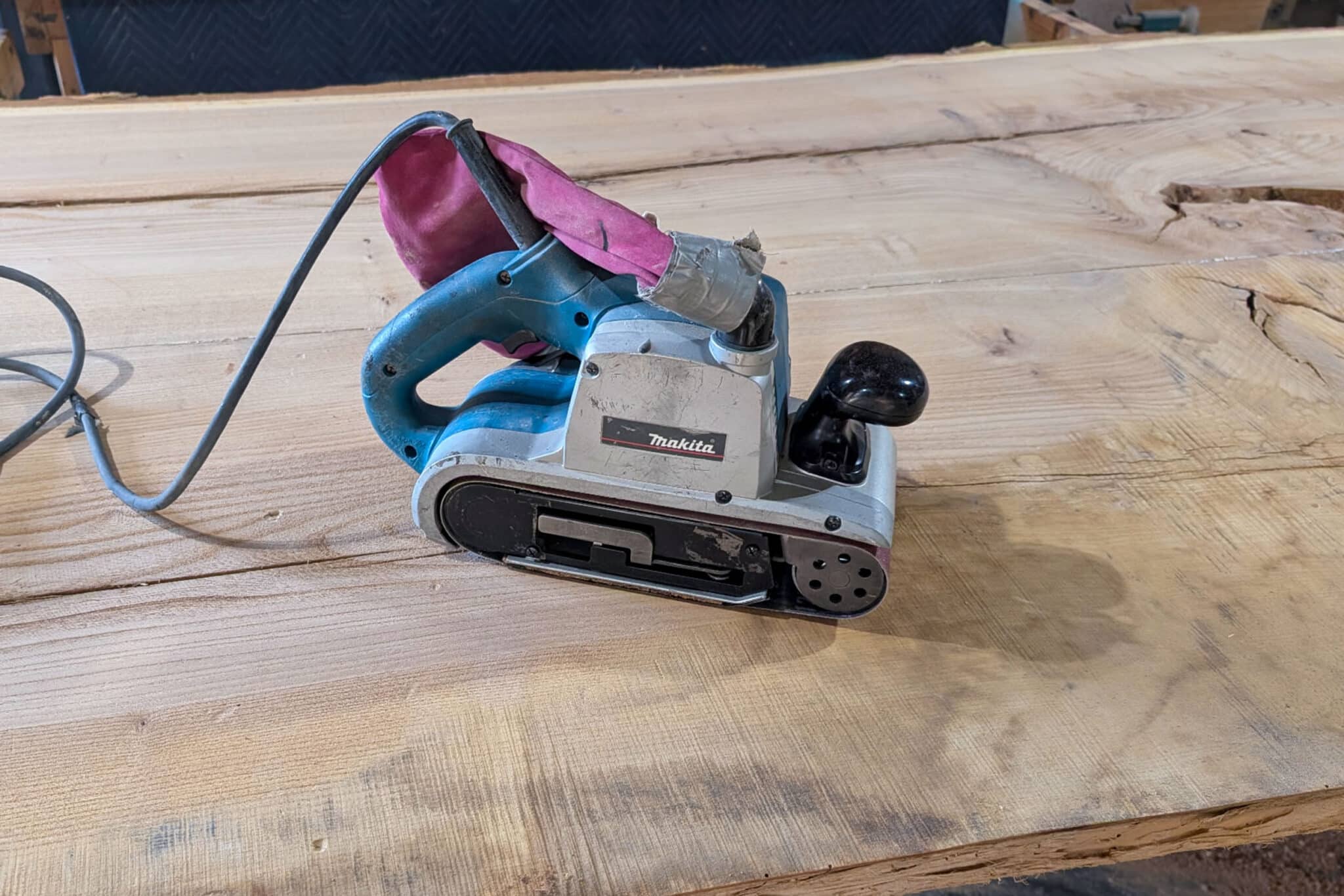
Belt Sander
While we do most of the heavy lifting when it comes to flattening your slab, some sanding is still in order. A belt sander is a good way to rapidly remove material to level and smooth your slab, however, it can be a bit aggressive if you don’t pay attention to a few key points.
First, use the correct sandpaper grit. Rough sand with 80 or 100 grit, moving up to a 120 grit, and then a 150 grit. You’ll finish sanding with the palm sander later.
Don’t push down on the sander. Let gravity do the work; there’s no need to work harder than necessary, and added pressure can cause gouging. It is best practice to always sand with the grain, never across it. Be careful not to tip the sander or change the speed or direction in the middle of the slab. To prevent the telltale U-shaped gouges at the ends of your slab, always run the sander half off the slab at either end.
Always keep your cord out of the path of the sander; a belt sander will eat your cord alive, and you don’t need that kind of excitement. It usually works pretty well to throw your cord over your shoulder.
If you don’t have a belt sander, here are a few good options:

Palm or Orbital Sander
The last power tool you’ll need is some sort of hand sander. We like a random orbital sander, but if all you have is a palm ¼ sheet sander, that will work too. Ostensibly, you could use a block of wood and a piece of sandpaper, but unless you’re looking for an arm workout, a power sander is a better option.
The reason we prefer a random orbital sander is that the random, elliptical motion gives you a better overall finish without the potential for identifiable sanding marks. They often have a bit more powerful motor than ¼ sheet sanders, which makes sanding go a bit quicker.
This sander is used for your final sand, so you’re going to start out with a 120 grit, moving up to a 150, 180, and/or 220 to get a really smooth finish. The goal here is to smooth out the sanding marks from the belt sander.
Once again, work with the grain, try not to go across it. This is less important with a random orbital sander, but it’s just a good practice to get into.
If you don’t have a random orbital sander, here are a few good options:
Conclusion
With just these three power tools, a few hand tools, and some gumption, you can craft your very own slab and achieve professional results. For step-by-step instructions on how to take a slab from our shop to your dining room, head over to this blog post to learn more.
We’re always ready to talk wood. Come check out our wood selection at our barn showroom in Wilder, ID. We’ve got slabs, rounds, and reclaimed wood of all types. There’s undoubtedly something there that will fit your needs.