
If you have a family that eats together, or if your family likes to host dinner and game nights, and you’ve never had adequate space for any of those things, what you need is a table that seats at least eight people. A table of this size can be pretty expensive, and even the cheapest 8-person table from Ikea costs $650. The quality of a table like this is passable, but it’s definitely not heirloom quality.
What can you do instead? Well, if you have a few power tools, some hand tools, and some table legs, you can craft your own easier than you might think. If George Nakashima could craft tables that are now worth tens of thousands of dollars using basic power tools and a respect for the materials, you probably can too.
Here’s what you need:
- Slab
- Table legs
- Circular saw
- Belt Sander
- Random orbital sander
- Straight edge
- Chalk line
- Tape measure
- Pencil
- Sandpaper
- Belt sander
- 80 grit, 120 grit
- Palm sander
- 120, 150, 180, 220 grit
- Belt sander

Where to start?
The first step is to consider your design. Often, when people mention a slab table, they’re referring to a live-edge slab table. This is one way to do it, and we’ll cover live-edge tables in this article. We’d also like to encourage you to consider a cut-edge slab table as well. Sometimes the organic nature of a live-edge isn’t your thing. A cut-edge slab is the solution.
After you’ve decided on your edge treatment, consider your overall dimensions. For a table to seat eight, it needs to be between 78 and 88 inches long and at least 36 inches wide. Here at River Valley Woodworks, we have slabs that are 40 to 48 inches wide, which are perfect for this project.
Now that you have your dimensions, visit our showroom to select your slab. We carry a variety of hardwood slabs harvested from trees local to the greater Boise, Idaho area. We’ll help you select a slab that suits your needs and load it. Keep in mind that our slabs are already milled flat and don’t need further planing.
Next, you need to select some legs to turn your slab into a table. For a DIY project, we’ve found that metal legs are the simplest and easiest to work with. A couple of reputable places to get steel legs are at hairpinlegs.com and diyhairpinlegs.com. Both are US-made, have a wide variety of legs, and are of top-notch quality.
Now that you have everything, let’s get started.
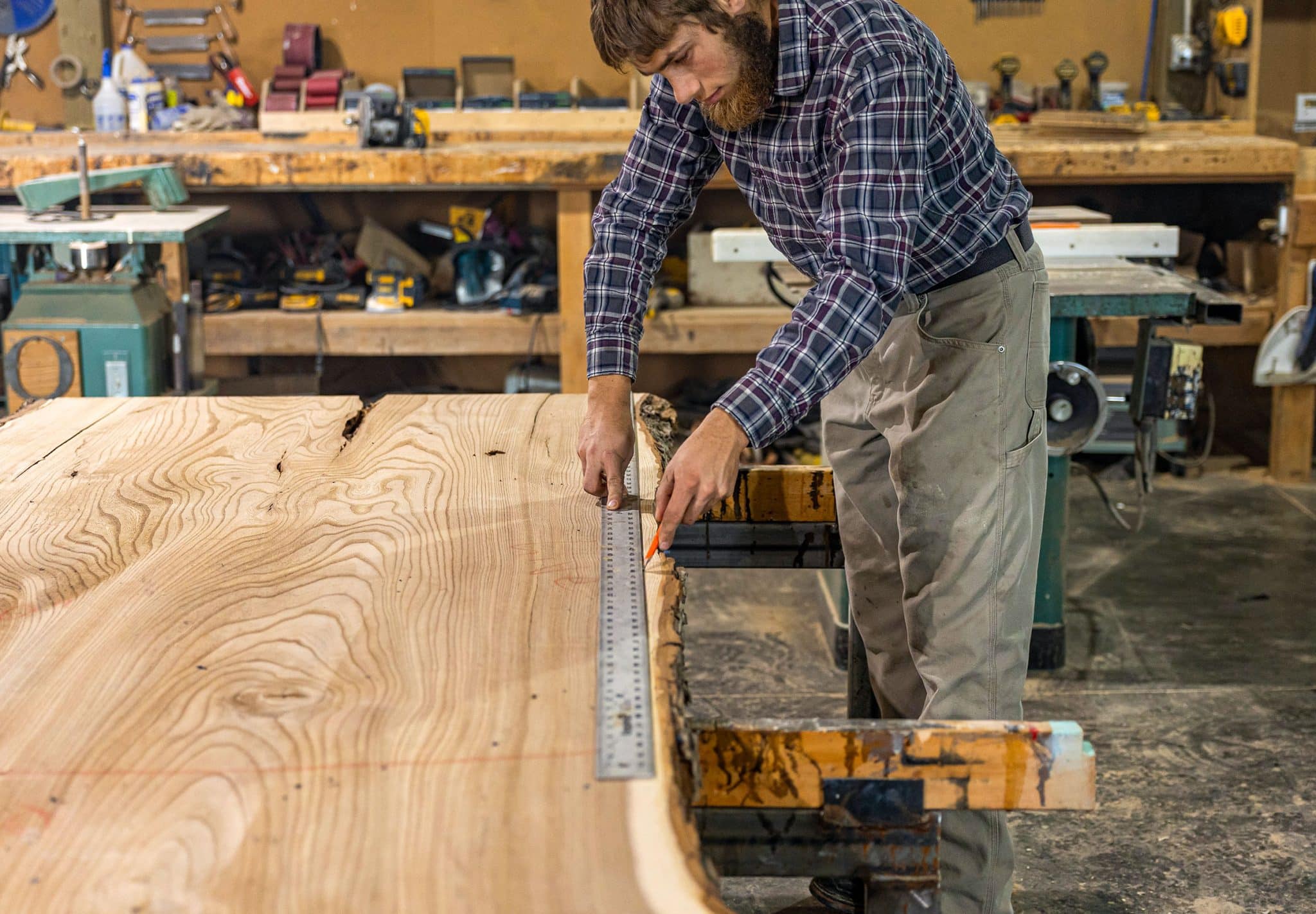
Step One: Layout
Lay your slab on a stout table, workbench, or sawhorses. This will enable you to make the necessary cuts to turn your slab into a table. Be careful when handling the slabs. They can be quite heavy, so be sure to have adequate help to lift and shift the wood.
The first step of layout is to determine where straight is. You want your cut ends to be perpendicular to your edges, regardless of whether you are creating a live-edge table or a cut-edge table. The best way to square the ends of your slab is to find and mark the slab’s centerline and then work from there. The best way to do this is to measure across the slab at several points, marking the center at each point. Once you have a series of center marks, use your straight edge to mark a line that bisects all of your marks. Now that you’ve determined the centerline, use a framing square to mark a line at each end of your slab perpendicular to the centerline. If you don’t have a framing square, don’t despair; math can save the day. For over 4,000 years, people have used the 3-4-5 method (the Pythagorean Theorem) to determine perfect right angles. If you’re unfamiliar with this method, check out this video.
If you’re making a cut-edge table, you’ll need to mark out your long edge cuts as well. Divide your final width in two, take the resulting number, measure from your centerline, and mark your final width from there.
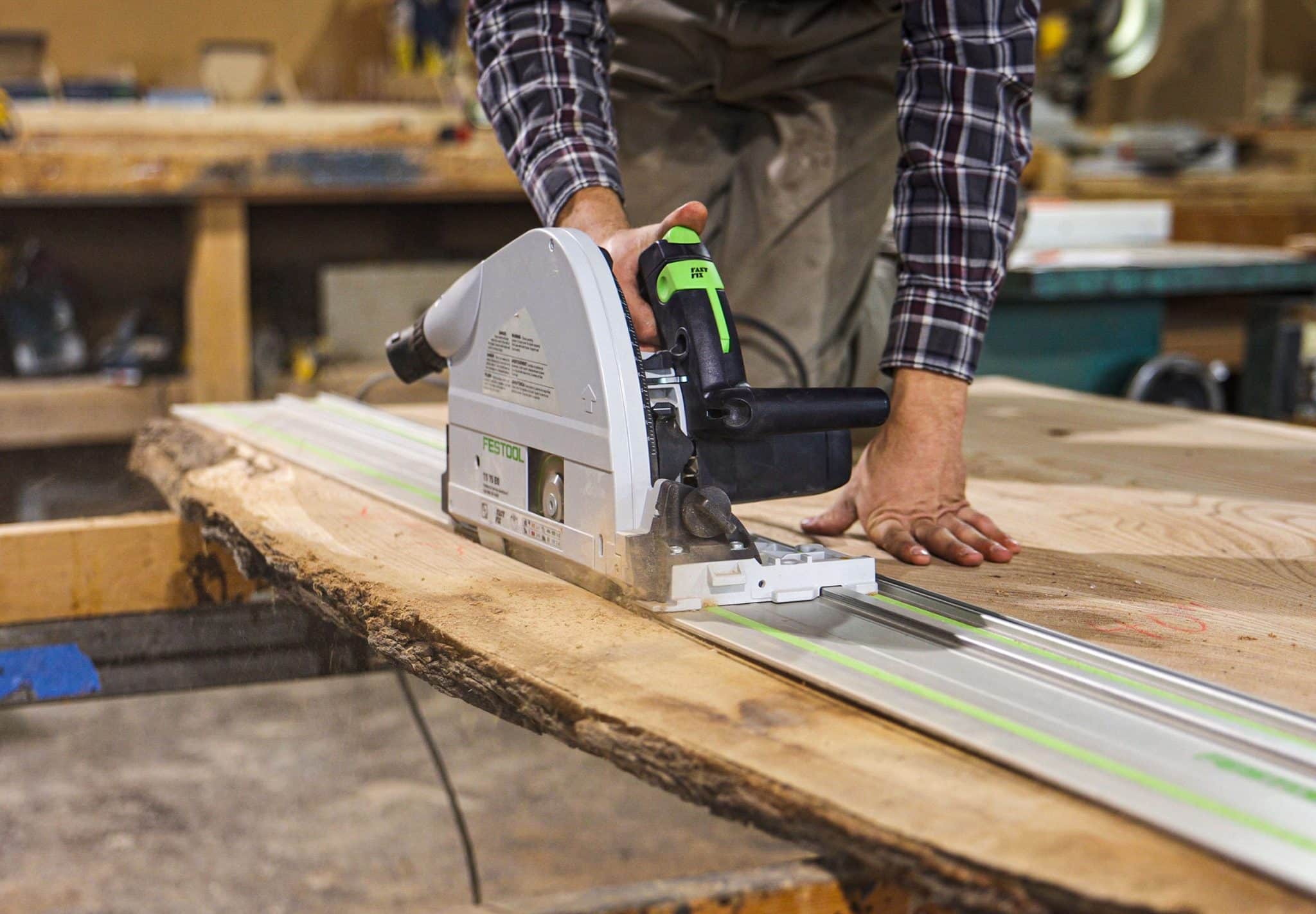
Step Two: Make Your Cuts
If you want to keep both live edges, you’ll only need to cut the ends square. If you’re making a cut-edge slab table, or if you’re creating a bookmatched slab using two pieces of wood, you’ll need to cut all four edges.
The easiest way to do this is to use a track saw. However, if you don’t have either of those things, don’t give up quite yet. With some patience and attention to detail, you can achieve great results with a straight edge or chalkline and a circular saw. Just carefully follow along your line using the built-in guides on your saw’s base plate (shoe).
Pro Tip: You can make a homemade track saw with a STRAIGHT board and some clamps. Here’s how: https://www.familyhandyman.com/project/how-to-use-a-circular-saw-long-cuts/
When using power tools, always wear hearing and eye protection. Keep long hair, loose clothing, and hoodie drawstrings safely out of the way. It may seem obvious, but always pay attention to where your hands are at all times. Keep them away from the blade.
Also, beware of kickback. This happens when the circular saw blade pinches or twists while making a cut. If you pay attention and take your time, this is largely avoidable.
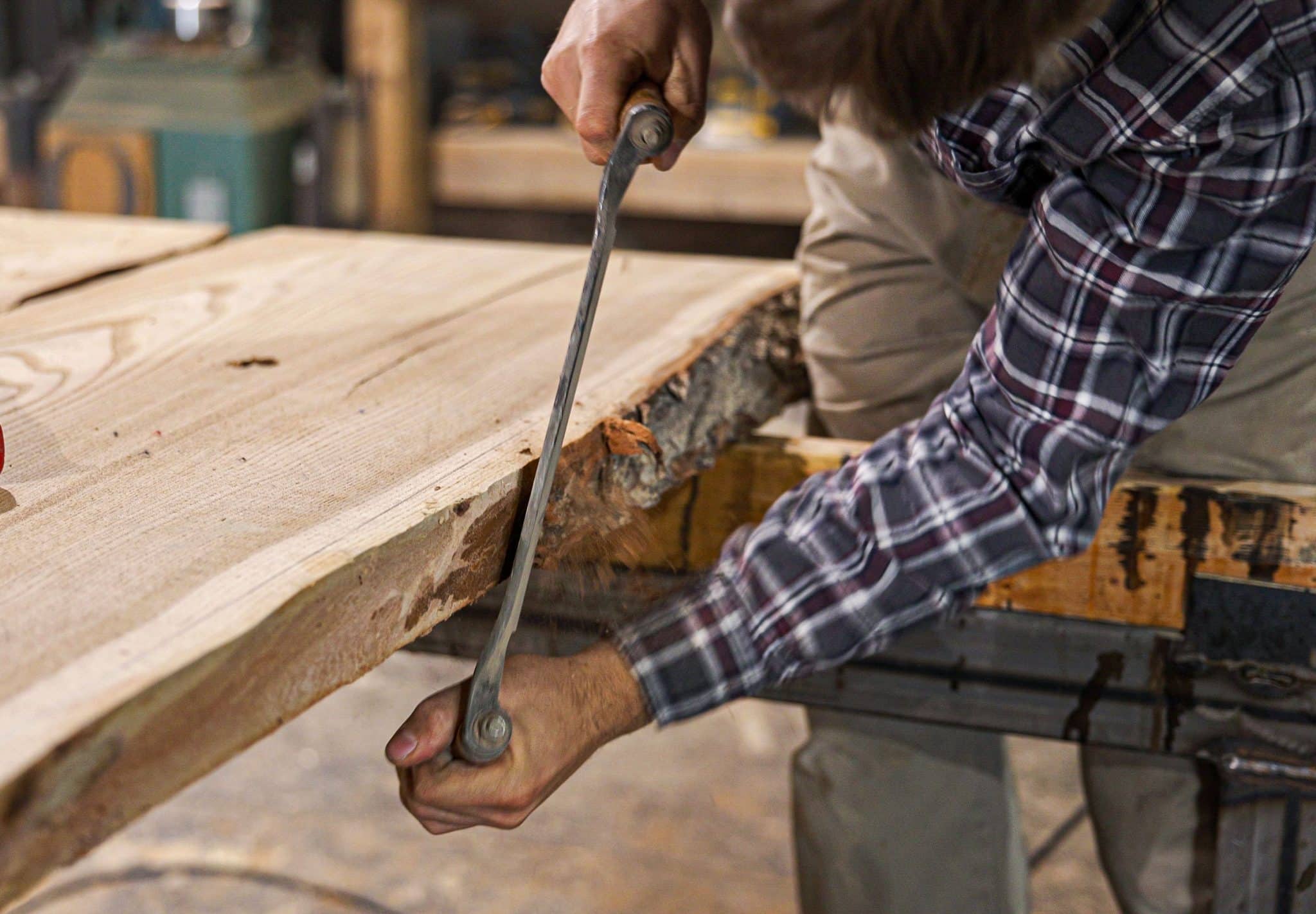
Step Three: Remove the Bark (live edge only)
Some of the bark falls off during the drying process, but if you’re keeping the live edge, you’ll need to remove whatever remains. If you leave the bark on, once the piece is placed in your home, the bark can shrink and expand at a different rate than the slab, causing unwanted cracks and delamination. To remove the bark, you only need a hammer and a chisel. Find the demarcation line between the bark and the wood and the bark. Strike the chisel with the hammer along this line, and the bark will separate from the wood. Don’t worry too much about getting it perfect. You’ll clean it up in the next step.
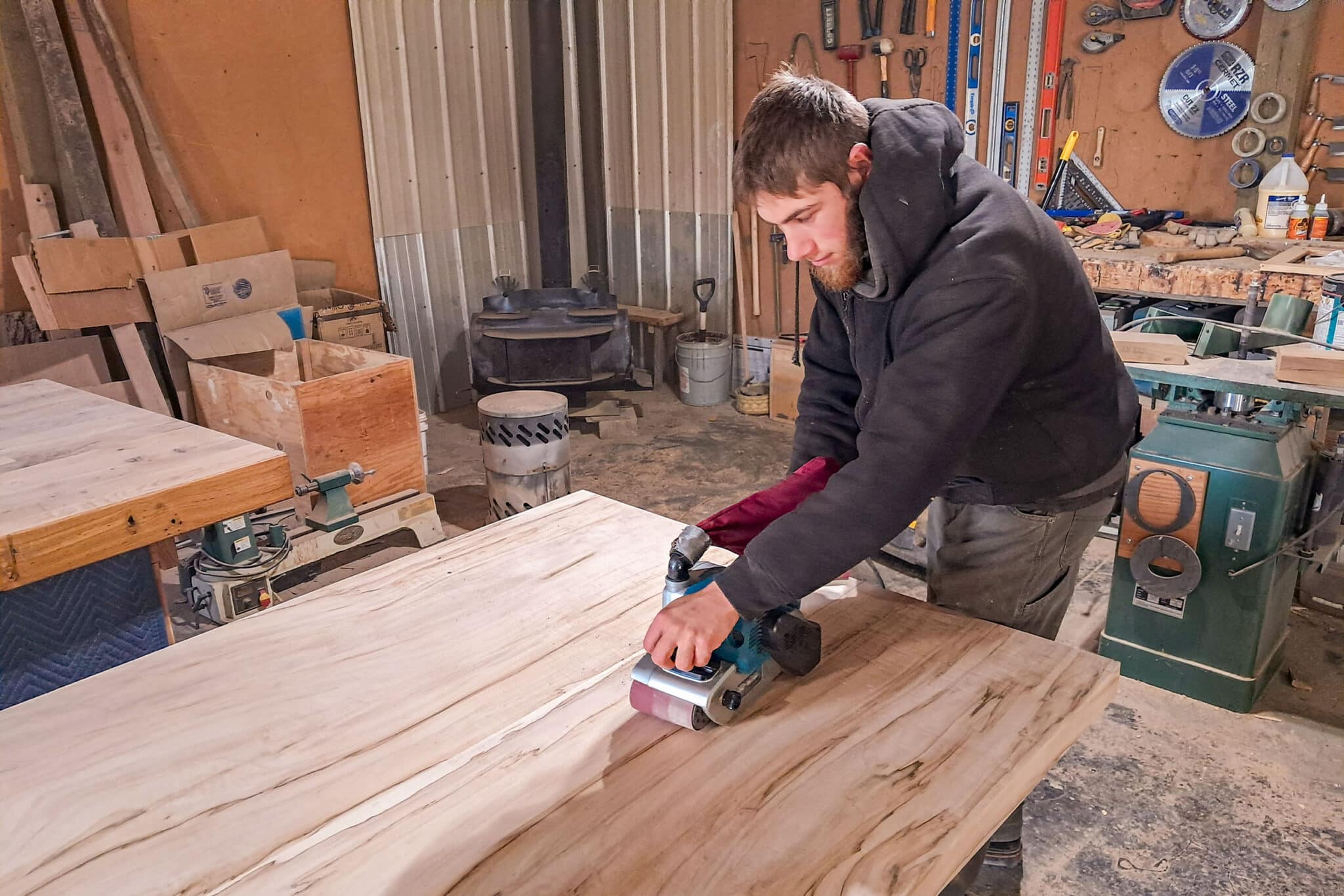
Step Four: Initial Sanding
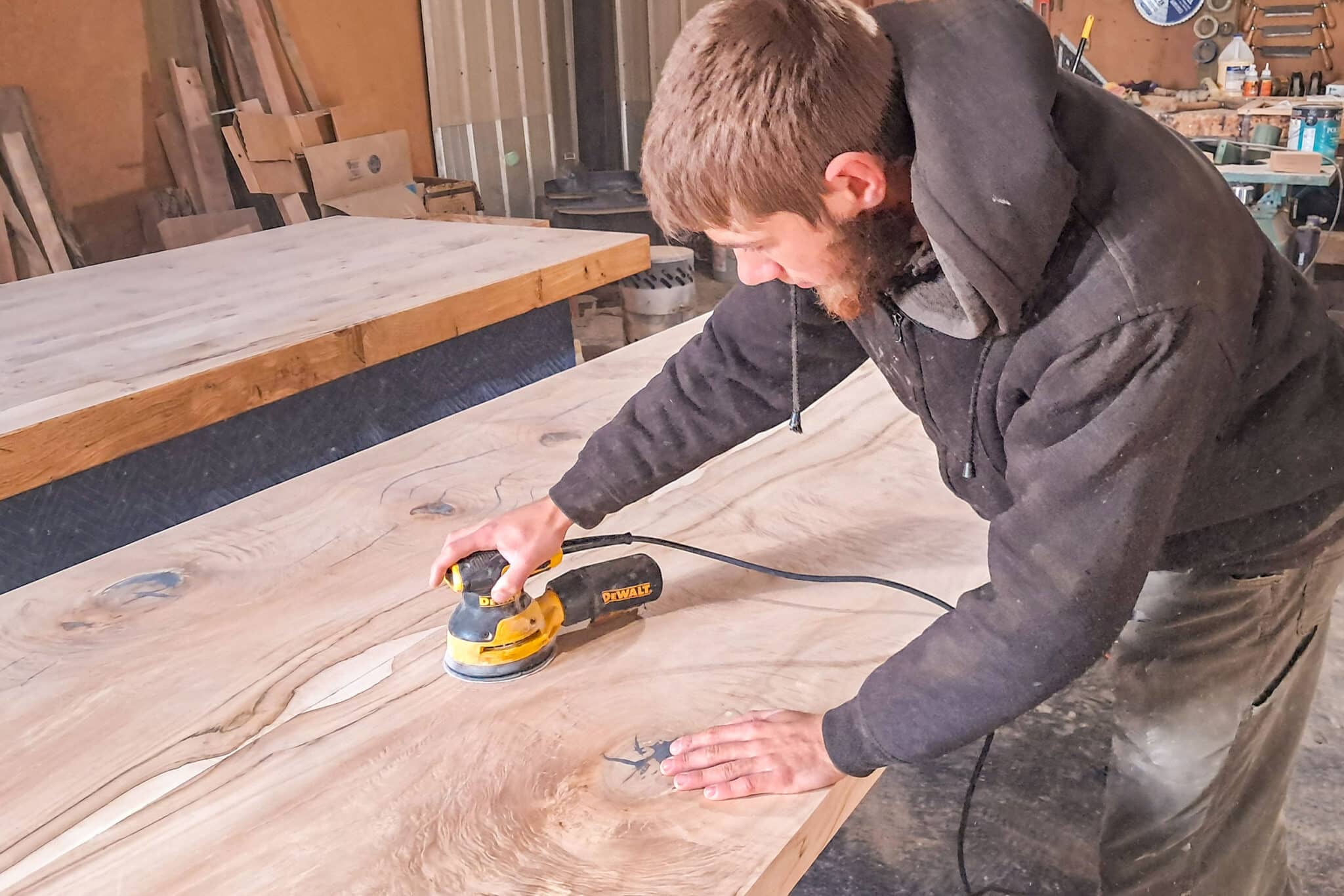
Now that you have the slab (or slabs) cut to size and the bark removed, it’s time to begin sanding. Our slabs are generally fairly flat and even, since we include a surfacing step in our milling process. This means minimal sanding for you.
For this initial step, you’ll need a belt sander to be most efficient. It is a great way to rapidly smooth and level your slab, but it is an aggressive tool that requires attention and control. Start your rough sanding with 80 grit, and progressively move up to 120 grit. The fine sanding will be done with a palm sander later. The key here is to let gravity do its job. There’s no need to bear down on the sander; that only invites gouging. Always sand in the general direction of the grain of the wood, using long strokes, keeping a constant speed, and paying attention to not rock the sander as you work.
To prevent the telltale U-shaped tracks from a belt sander, run the sander halfway off the slab at each end, keeping it flat and level. Most importantly, keep your cord over your shoulder and out of the way. A belt sander will eat a power cord alive, and that’s the kind of excitement you’re better off avoiding.
Step Five: Finish Sanding
When you’ve gotten to the 220 grit stage and made an initial pass with the sander and gotten the wood satisfactorily smooth, there’s a pro move that really can make your piece amazing. Set your sander aside and grab a fairly damp rag, and wet the surface of the wood. This will pop the grain slightly and make the piece rough again. Hit it again with the 220 grit sandpaper to get a really smooth finish.
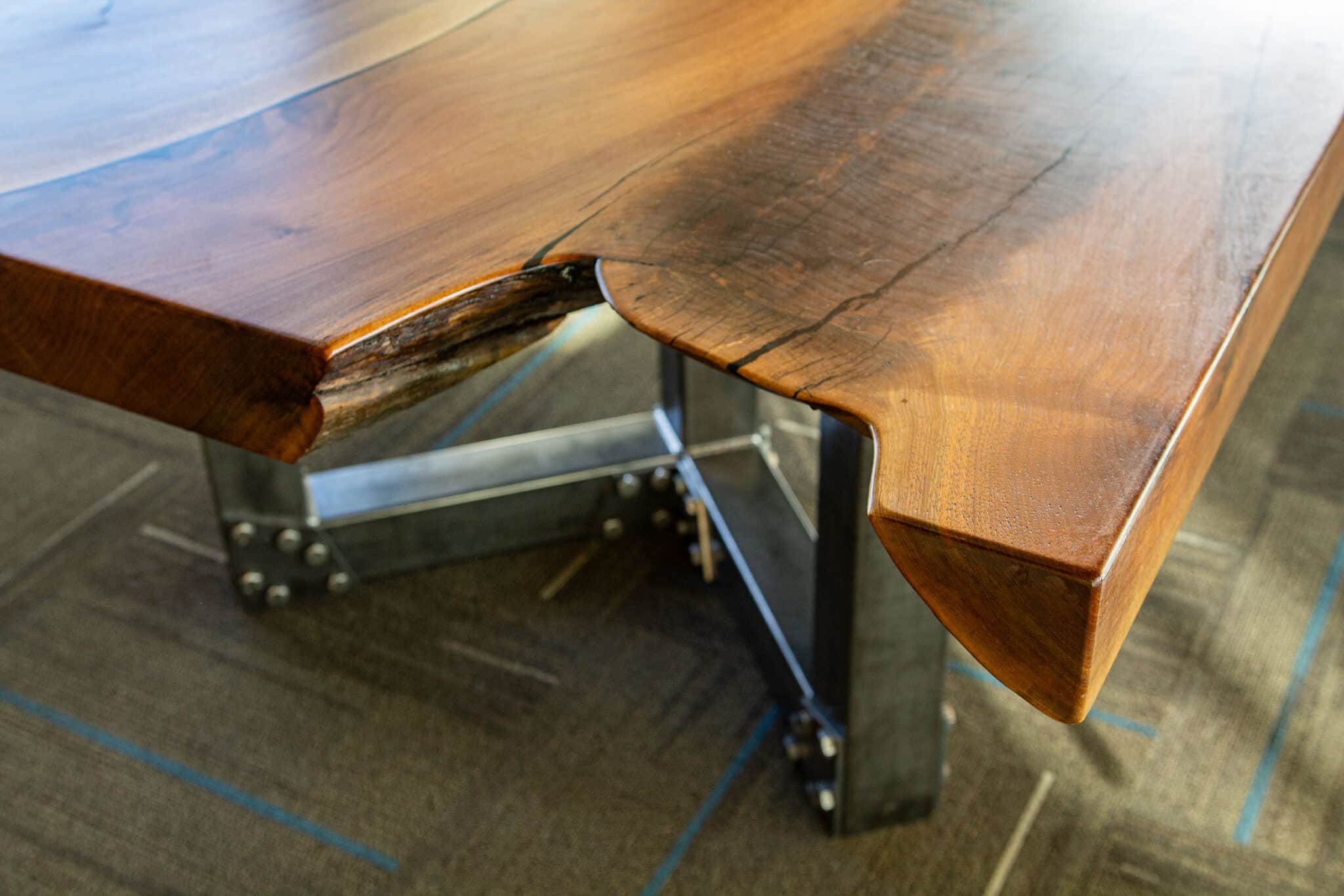
Step 6: Attach the Legs
As we said earlier, metal legs are the easiest and often the most economically feasible. Follow the manufacturer’s instructions for whatever type of legs you choose.
Step 7: Finish the Table
There are as many ways to finish wood as there are kinds of wood. Basically, they break down into a few categories: oil- or water-based, and sprayed-on or hand-applied.
One upfront fact about finishing: using any oil- or urethane-based product will produce a richer, darker, warmer color. Not everyone wants that all the time. If you want the wood to retain its natural color, use a water-based finish. Secondly, we’re a bit leery of spraying finishes, especially in a DIY application like this one. We’re just going to be discussing hand-applied finishes here.
Water-based finishes have a reputation for poor durability and low hardness. This is largely true, but not if you get a bit creative in your finish choices. We’ve found that a two-part water-based hardwood floor finish, such as Bona Traffic HD or Loba 2K, has the requisite hardness necessary for a table. The challenge is that water-based finishes dry quickly, leaving brush marks. For large tabletops, we recommend buying the floor-finishing attachments that your hardwood flooring company recommends for floors. If your table is relatively small, say smaller than 72″x36″, you can probably get away with using a paintbrush.
For a rich, hand-rubbed finish, we use Waterlox Tung Oil. Apply it with a lint-free cloth (an old T-shirt works well), soaked in oil (wear nitrile gloves), and wipe it on, taking care to avoid streaks. Apply the first coat fairly heavily, wiping smoothly from one end of the table to the other. The first coat is forgiving since much of it soaks in, and minor blemishes can be corrected with later coats. Once dry, inspect the table closely for scratches, glue spots, or other flaws. Resand any problem areas, then lightly sand the entire surface with 220-grit so future coats blend evenly. Apply two more thin sealer coats, allowing each to dry to the touch. After curing, hand-sand the table with 400-grit to remove finish burrs. If the finish gums up in your paper, it isn’t ready yet.
After the third coat is cured and sanded, apply three thin coats of Satin Waterlox Tung oil using a fresh lint-free rag each time. Soak the rag, spread the oil evenly, and finish with long, continuous strokes from end to end. Add each coat only when the previous one is no longer tacky. The fourth, fifth, and sixth coats should be applied very thin and smooth. Add additional coats as desired.
Finally, another great finish option is Rubio Monocoat. It is plant-based, durable, and comes in multiple colors, but it is fairly expensive. Of all finishes, Monocoat is the easiest to apply and the hardest to mess up. It will give your furniture a finish about halfway between water-based and oil-based finishes. It does not create as rich and warm a look as the oils, but it is richer and warmer than the water-based products. Simply follow the manufacturer’s instructions for best results.
A note on rags: Spread used rags to dry outside immediately, well away from anything flammable. Wet finish rags can spontaneously combust. Some people think that’s a myth, but we’ve had it happen twice, so now we don’t take chances. Once the rags dry hard, they can be thrown away.
Conclusion
If you follow these steps correctly, you should end up with an heirloom-quality table that should serve you for years to come. All that remains is for you to gather some friends or family around your table to enjoy it together. After all, isn’t that what tables are for?